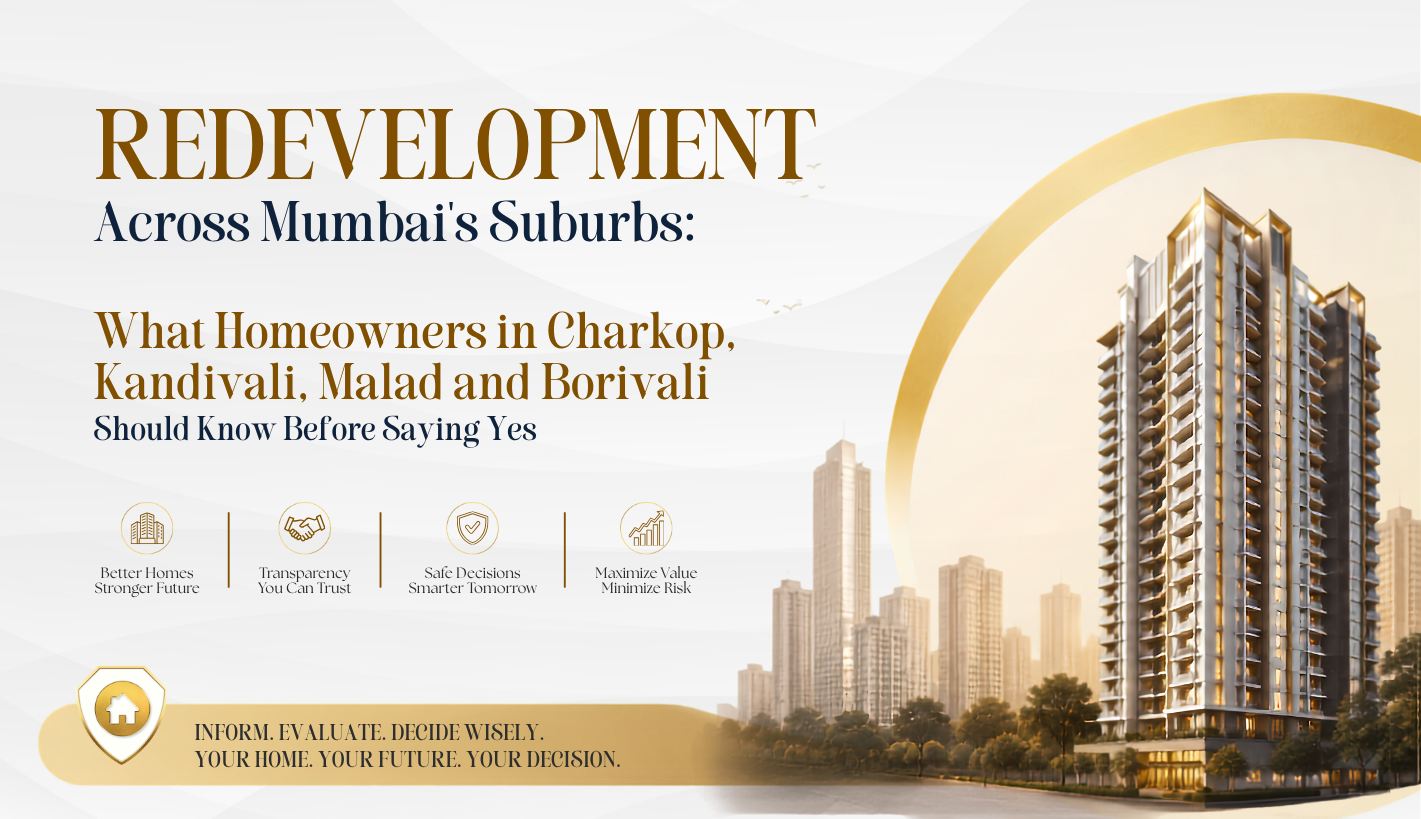
The portion of stock of the above 5 decades or more among the housing of Kandivali, Malad, Borivali, Goregaon, Andheri, Dahisar as well as Mira Road, combined with the increased scarcity of the ground available in these suburbs, is causing red development in increase at a brisk clip. That combination - ageing buildings and limited fresh land - is what's driving the redevelopment wave. For most societies, redevelopment isn't a lifestyle upgrade decision anymore. It's becoming a structural necessity. For homeowners, that means understanding the process matters as much as choosing the right developer.
Redevelopment follows a defined sequence, not an improvised one. Here's the shape of it: Development rights are transferred by the society to a developer through a formal, negotiated agreement - this is the starting point of any legitimate project. The Development Agreement is then registered, legally binding both parties to the terms discussed, including flat sizes, timelines, and compensation. The PAAA (Permanent Alternate Accommodation Agreement) follows - a document unique to each resident, guaranteeing their specific unit and terms in the new building. An IOD (Intimation of Disapproval) - effectively the municipal go-ahead - must be secured before any demolition begins. Only then does demolition and construction proceed, with progress tracked and publicly visible through MahaRERA, Maharashtra's real estate regulatory authority. Each step exists to protect residents. Skipping or rushing any of them is usually where redevelopment projects run into trouble.
The PAAA is the document every resident should read most carefully - it's the one that directly concerns their home. In plain terms, it guarantees the specific unit a resident will receive in the new building, the timeline for possession, and the terms of alternate accommodation while construction is underway. It's not a marketing promise. It's a registered agreement, individual to each flat owner, meant to remove ambiguity about what happens to their home during the transition. A developer's willingness to execute PAAAs clearly and early - rather than after construction has already started - is one of the simplest indicators of how transparently a project is being run.
Virgo Infraspace's Charkop Sector 1 redevelopment brings together five separate plots into a single, cohesive development - twin towers of 47 and 19 storeys, with 32 amenities planned across the project. Consolidating five plots into one redevelopment is not a simple undertaking - it requires alignment across multiple societies, a unified Development Agreement structure, and a phased approach to construction and handover. It's the kind of project that only works when the approvals and agreements are sequenced correctly from the start - which is the same discipline we bring to every redevelopment we take on.
Before a society says yes to any redevelopment proposal, these are worth asking directly:
Is the Development Agreement registered, and can we see it? Will PAAA be executed individually for each flat, and when?
Is the project's MahaRERA registration published and up to date? What happens to alternate accommodation if the construction timeline shifts? Can we speak to residents from a completed or ongoing project by the same developer? A developer who answers these clearly, with documentation to back it up, is operating the way redevelopment is meant to work.
Request a Redevelopment Consultation to understand what this process would look like for your society.
